When I finished college a degree in Early Education. I was very excited to start my career, but finding that I was running into challenges and barriers. I have Cerebral Palsy with Dystonia. Even though I can move and communicate—walking, running, talking—my body’s always in motion with trembling, cramping, and jerking spells. Holding onto things isn’t always easy, but I’ve come up with my own strategies that work for me.
As I looked for work people perceived that I was drunk or on drugs. They assume that I could not possibly understand information let alone teach students. I was facing “barriers” in the workplace by other’s perceiving what I could and couldn’t do. Without talking with me about my disability or how I could complete a task successfully.
So what does “barriers ” mean?
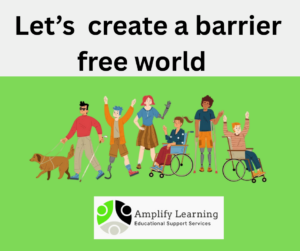
There are lots of barriers people with disabilities face every day. This means anything that makes it harder for people to take part in everyday life – like going to school, getting that job, even using public spaces. Barriers come in many forms. For example: A building’s without a ramp or elevator is a physical barrier for someone who uses wheelchairs, canes, or walkers.
A website’s that doesn’t work for a screen reader or the font and sizing can’t be adjusted. this would be called a digital barrier for someone who has low vision.
Emails that come in small font and hard to understand the information that was given. This could be a barrier for a neuro divergent to understand.
A job interview where the employer assumes a person with a disability can’t do the work is an attitudinal barrier.
Let’s explore some barriers in this blog post, especially when it comes to work.
History of barriers for people with disabilities.
People with disabilities weather born with or came with in life, were thought of as an outcast, burden to society and not excepted in the community most individuals were locked away, put into institutions, or kept behind closed doors at home, not to be seen in public. Until the late 20th century, the start of mindset shifting. Although disabilities was then seen as a medical problem: There was something “wrong” the body or mind that needed to be fixed.
Society expectations were people with disabilities needed to change and fit into the “normal” world. If they couldn’t they were left out without help or kept in institutions.
In the late 1970s movement started to recognize people with disabilities. It 1981 the government of Canada recognize people with physical disability were people under the law and right to gain employment and vote. Unfortunately not all people with disabilities received that right. In 1991 the government finally moved for all people with disabilities had the right to vote, to gain access to employment and are persons under the law. In 2017 the act for accessibility was passed to update the accessibility plans for Canada. In 2021 the courts ruled in favor of decimation of people facing disability this was the largest human right issue in Canadian history.
This lead to the Nova Scotia Human rights Remedy,2023 the start of a five year plan.
One of the first activists was Marty Wexler. Helping to break barriers for independent living, Marty was one of the founding member of the Disability Rights Coalition of Nova Scotia. He championed for human rights and created the first group home for people with disabilities in 1979 in Nova Scotia.
After my diagnosis of Cerebral Palsy, my parents were told by medical professionals to place me in an institution, where I would not be a burden to them and receive care. I am so thankful that my parents did not listen to this advice and raised me to be independent.
Mike Oliver, from the United Kingdom helped develop how other’s think about disabilities called ” social model” in 1983.
This model says are not disabled by their body or mind it is the barriers that the world has placed on them. Some may have Cerebral Palsy a childhood disability condition. But it does mean that they are all disabled. It what makes life harder because of the barriers society put in place. Like building without a ramp or websites that are not accessible to understand or people perceived thoughts are what causes barriers.
The idea of barriers is the main point to the social model. A barrier is anything in the environment—like buildings, technology, or attitudes, education, employment —that makes it harder for people with disabilities to take part in everyday life.
If we look at my condition Cerebral Palsy they view me as a medically disabled because I of the way my body works. My Cerebral palsy effects my left side of my body and with the Dystonia my whole body shakes which makes it hard to feed, clothe myself and at times need assistance.
The social model would say I am disabled by the world that it is built for able bodied people. Where there no ramps to get into building, heavy doors to open, no signage to let people know information, no alerts to cross traffic. These are just examples of barriers created by society, not by my Cerebral Palsy. If these barriers didn’t exist they may not see disability, but see the ability of the person and what they can do.
People can make things harder, even if they don’t mean to. This called interpersonal barriers, this when how others treat people with disabilities.
Especially when there are misunderstandings, biases or negative attitudes about the person with the disability .
These kinds of barriers can happen between individual people, within groups of people, or across groups of people especially in workplaces.
These barriers may look like stigma, discrimination and ableism.
There a belief by not having a disability you are called “Normal” and if you have a disability you are classified as “less than”.
An example, employers could think workers with disabilities would be less productive, a burden, need someone to “babysit” them as they work. They also could believe accommodations would be too expensive. Although these ideas have been proven wrong in many cases.
If we look at what Mark Wafer, from Ontario Canada. A person with a disability started his own business a franchise of Tim Hortons, he hire’s individuals with disabilities, he said that by hiring people with disabilities has brought up his profit levels and made a positive change for his business and the individuals that work form him. He helping to break barriers in the employment world for people with disabilities.
When looking at my case, in Nova Scotia, I found barriers to start right at the interview stage. Employers love my resume but when they meet me things would go downhill from there. They saw a women that shakes and walks differently than others and they assumed that I could not do the job applied for this would be called interpersonal barrier. The interviewer’s at times seemed uncomfortable and sometimes distracted instead of focusing my qualifications. Not asking questions related to the job or what my experience is with the position I applied for. After interview feeling like I was not taken seriously as a professional.
Unfortunately this barrier is also called assumptions and attitude of the interviewer. Mind you that the interviewer may not meant to be disrespectful, but by showing lack of focus and understanding made me feel excluded.
We also bring our own barriers this comes from how we have been treated by other’s.
This would be called individual barrier, this could also be about how the person sees themselves and what they believe.
For some we struggle with self-confidence, because of how they been negatively treated by others, then they may view themselves less than.
There are lots of ways that individual barriers can impact the person, even at work.
For some may not feel that they can’t ask their employers for accommodation because they feel that they would be looked down a pond or less than.
This happened to me I was worried that if I asked for an economical mouse and a second monitor to support me working on the computer. Feeling if I asked for these accommodations I would be let go or looked at as less than others that do the same job. For this I created my own barrier of not having the confidence to speak up and advocate for myself.
When we look at our communities, the barriers are things like public transportation, restaurants, apartment buildings, grocery, retail stores, parks, public spaces, farmers markets or festivals.
Finding that our public transportation can be unreliable, or unavailable for people with disabilities. Or our shopping malls not accessible or inclusive.
I wanted to buy a clothes basket and went to the people’s store in the Truro mall. This mall is accessible to get in , with many different stores to look or buy something from. I walked into the store call “People’s” I was looking around to find the clothes basket I saw ion there flyer. As I was walking around the clerk in the store asked me what I was doing. I told her I was looking around and for a clothes basket. She followed me around the store then she asked me to leave her store.
When I asked why she said ” We don’t want your business from your kind.” I refused to go. So she called the police and had me escorted out.
I asked “why” to the police they said, “people like me didn’t belong in their store and they have the right not serving you. Although I could come back when I was sober.”
They would listen to me telling them I had a disability. I had to leave with no clothes basket in hand. The next day I returned hoping to speak to the manger and hoping that I would educate them that there are people with disabilities that can go shopping on our own and we are capable to be independent not needing support worker attending with us.
As years have gone by there is more acceptance in our communities which is welcoming to feel included. Although there are still barriers that we face every day.
As well the saying “It’s just the way things are”. Major social institutions like schools, workplaces, banks, insurance companies
can create barriers called “institutional barriers” for people of disability.
Lot of these intuitions may lack accessible features like a accessible washroom, ramps for entry, washrooms, poor quality of accommodations or none at all. For some with workplace cultures are not inclusive or welcoming for employees with their coworkers.
My last job seemed like a good fit. They were welcoming and providing accommodations to support my work. But the staff was another story, especially the manager, they made me questions how I was doing my job, making me feel less than which reduce my confidence within myself. They would complain, and micro manage how to do my job. This made it harder for me to stay and feel valued. I felted that I was NOT taken seriously, like I was a token to say “Oh, we hire people with disabilities,” so it looks good for them as a company.
There are many different barriers that people can experience when looking for work or trying to get a promotion at work. Every time I applied for promotion, was always turned down, one employer stated that I was only good for entry level because they felt my disability got in the way of me doing my job.
By identifying these barriers and the impacts they have on people with disabilities, we can begin to fix them and make work more accessible for everyone.
Want to learn more about barriers that people with disabilities face at work and life.
Contact Amplify Learning to learn more